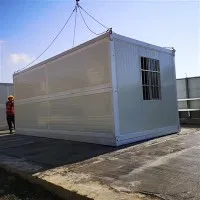
In Shanghai Xinzhuang Chunshen Lake, the garden of the woods there are a few bright red "butterflies" fluttering, they are the container building to create a "red living room" party service station.

The overall shell of the building is elegantly curved and painted with bright and colorful patterns, breaking the stereotype that containers have to be square.


The reason why the party service station choose container building, in addition to the process, construction cycle is short, beautiful shape, cost control, low-carbon environmental protection and other factors, but also do not want to destroy the original paving of the square. Its interior decoration is similar to traditional buildings, even visually more transparent and open.

At present, this new type of customized shaped combination of container buildings can be restored, the second build into other shapes, or disassembled into small unit modules to be used again.
Container building theoretical life of 25 years, as a public facility, service facilities, commercial facilities, in fact, has been enough. Therefore, more and more creative parks, commercial streets began to choose the container building.
Some people worry about the container housing interior will not tend to be simple, a kind of live in the feeling of the shed, can not be comparable to the comfort of the hotel. In fact, this is a misunderstanding. Custom-made personalized boutique projects, the house also take personalized finishes mode, plus insulation, laying pipelines, installed wall panel interior finishes, etc., and traditional interior works similar, can be created and high star hotel housing is not the same, plus the shell personalized painting, more attractive to young people.
In 2016, the General Office of the State Council issued the "Guidance on the vigorous development of assembled buildings", the future of China will vigorously promote assembled buildings, with about 10 years to make the proportion of assembled buildings to 30% of new construction area.
But at present, the actual proportion of assembled buildings in China is less than 5%, and there is a gap with developed countries. Some industry experts predict that in the next 10 years, China's market size of assembled buildings will reach a cumulative total of 2.5 trillion yuan, the market development space is huge.
Among them, the subdivision of the type of container has become increasingly hot in recent years. Compared with the traditional construction method, it can reduce the construction of water, concrete loss of about 60%, reduce construction waste and decoration waste of about 70%, the overall energy saving half, production efficiency increased by two to three times. Low-carbon environmental protection and energy saving, flexible and lightweight can be moved.
More critically, the container building approval does not occupy the building land index, sales offices, stations, exhibitions and even commercial streets, industrial parks, the use of container building procedures are relatively simple.
In the future, in the urban renewal scene, it can have more flexible use and plasticity than imagined. And in the countryside, natural environment, it is less restricted, but also play a variety of ways, endless imagination.

In some global cities, mobile hotels, cafes and stores converted from shipping containers can already be found on the streets. In London, a container building is used as a dormitory, which is eight stories high and is a technical innovation.
In the mid-20th century, the famous Japanese architect Kenzo Tange started the "Metabolism School", an influential school of architecture that influenced a number of famous architects such as Fumihiko Makoto, Kiyotake Kiyotsu, and Kisho Kurokawa.
They emphasized that cities are constantly growing, renewing and decaying, and strongly advocated the adoption of new technologies to solve problems, opposing the old view of cities and buildings as fixed places. Their research shifted from architecture to the planning of future cities. This school believes that architectural design needs to adapt to the organic growth, change, metabolism, and renewal of the city.
Today, container architecture makes all of this feasible. In the context of increasingly constrained urban sites, increased uncertainties, and increasingly diverse renewal needs, container architecture may no longer be synonymous with rudimentary industry, but offers infinite possibilities for future urban renewal, growth, and response to risky change.